Q&A with Jemma Gunning.
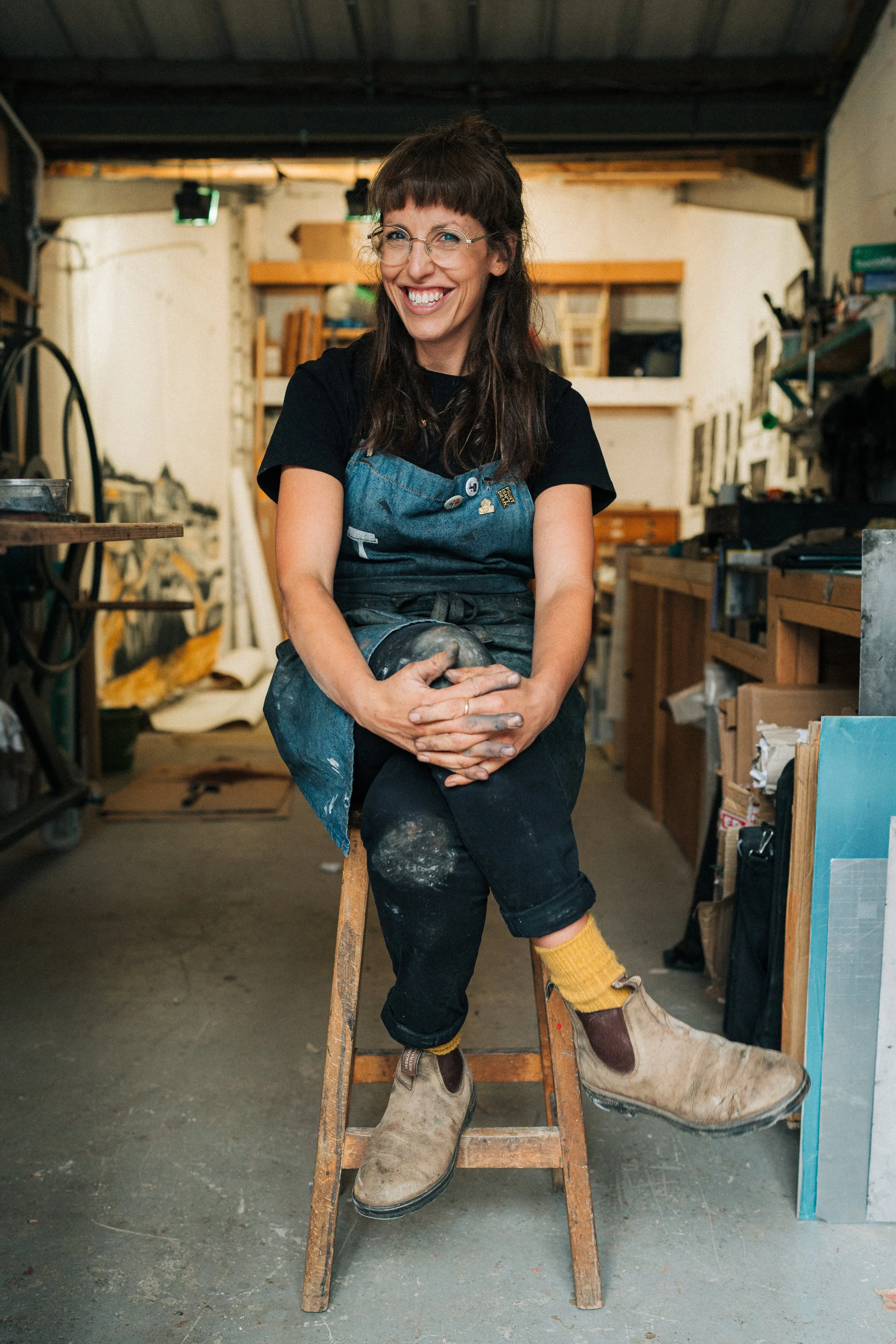
Ahead of our ‘Printmaking and Coastal Walking’ retreat we sat down with with Jemma Gunning to hear more about her influences and process.
Jemma is a Bristol based print maker who uses traditional techniques to explore ‘themes of decay, change, and the passage of time within natural and built environments.’
Q. How do you work? Please can you tell us a bit about your creative process?
“My process often begins with walking. I like to sketch on location, take notes, sometimes collect small fragments, but it’s less about accurate documentation and more about absorbing atmosphere.
Back in the studio, I translate those experiences through printmaking. I work quite physically, layering, wiping back, reworking plates. I’m interested in surfaces that feel weathered or eroded, prints that hold a sense of time. Etching, monotype and lithography allow me to capture both delicacy and deep, inky blacks.”
Q. How did you start your printmaking journey? What first inspired you?
“I began printmaking through a chance encounter. I was visiting Somerset House and, rather randomly, as I went to use the toilet I passed a display of monotypes by John Virtue. I had no idea what a monotype was, but the images completely stopped me in my tracks.
When I returned to college, I asked the print technician if they could show me the process. They demonstrated how a monotype works and from that moment on I was hooked.
I spent the next three years of my BA immersed in monoprinting and intaglio processes. It was everything about printmaking that captivated me, the smell of the inks, the mess of the studio, the physicality of the presses, and the unpredictability of the results. That sense of discovery still excites me just as much today.”
What specific tools do you enjoy working with the most at the moment?
“At the moment I’ve just started my first etching of the year, and I’m really enjoying making marks with something as simple as a scrappy bit of kitchen paper. I often favour low-tech tools because they create unexpected textures and marks that you wouldn’t get with more controlled equipment. That sense of experimentation, using whatever is at hand keeps the process playful and often leads to the most interesting results.”
Q. Who inspires you the most — no rules here — artist, friend, family member, anyone?
“I’m inspired by people who are deeply connected to what they do and genuinely love their practice, especially those working with craft, the land, or the environment. There’s something powerful about that level of dedication and attentiveness.
Seeing people commit themselves so fully to their work inspires me to keep putting one foot in front of the other, walking, observing, drawing and continuing to make. It’s that quiet persistence and connection to place that I find most motivating.”
Q. Is there a favourite project or assignment from your past that proved pivotal in your life? Can you tell us a little about it?
“During the residency I spent a lot of time exploring the quarries and altered landscapes of the area. I became fascinated by these spaces where human industry and geology collide — places where the land has been dramatically cut into and reshaped. That experience sparked a much deeper interest in landscapes that have been transformed by human activity.
This led me to apply for and be selected as an artist in residence with the Earth Sciences department at the University of Bristol, where I began thinking more closely about geological time, extraction and environmental change.
From there, another residency took me to Venice. Driving through the Alps on the way there, I witnessed first-hand the dramatic effects of climate change — receding glaciers and rapidly changing mountain landscapes. That journey connected many threads in my practice, linking mountain environments with the fragile, flood-prone landscape of Venice.
Those experiences have ultimately led to my selection for the The Arctic Circle residency this May, where I’ll be travelling to the Arctic to continue exploring how artists can record and respond to rapidly changing environments. It feels like a natural continuation of the questions that first began during that time in Derbyshire.”
Q. Sounds of the studio — what are you listening to? Podcasts, playlists? What sounds motivate you?
“It depends on the stage of making. When I’m drawing or planning, I often work in silence. When I’m inking plates or printing, I love something immersive — long-form podcasts or ambient music.
I listen to a lot of nature-based writing podcasts and conversations about landscape, as well as instrumental playlists. Sometimes I simply open the studio windows and let the outside sounds in — wind, rain, passing footsteps — they feel like part of the work.”
Q. What do you enjoy most about retreats and teaching? What inspired you to share your skills and knowledge with others as a facilitator?
“I love the shift that happens on retreats, the slowing down, the permission to focus. People arrive busy and leave seeing differently. That transformation is incredibly special to witness.
Teaching feels like an extension of my practice. Printmaking can seem technical or intimidating, but once someone pulls their first print, something clicks. I’m passionate about demystifying the process and creating supportive spaces where people feel confident to experiment.
Retreats are particularly powerful because we’re making work in direct response to place, which feels very true to how I work myself.”
Q. Please tell us about your daily rituals as an artist? Can be as mundane as possible…
“I try to walk every day, even if it’s just a short loop to clear my head. Walking is often where ideas begin to form, it gives me space to observe, notice small details in the landscape and let my mind wander a little.
Endless cups of tea feature heavily throughout the day in the studio, helping to fuel the physicality of printmaking, along with the occasional bite of dark chocolate. Printmaking itself has a rhythm to it, inking plates, wiping them back, running them through the press and I enjoy settling into that steady, repetitive flow.
Eating well is also really important to me. I love cooking simple tasty wholefoods; it feels like a way of feeding both my energy and my creativity.”